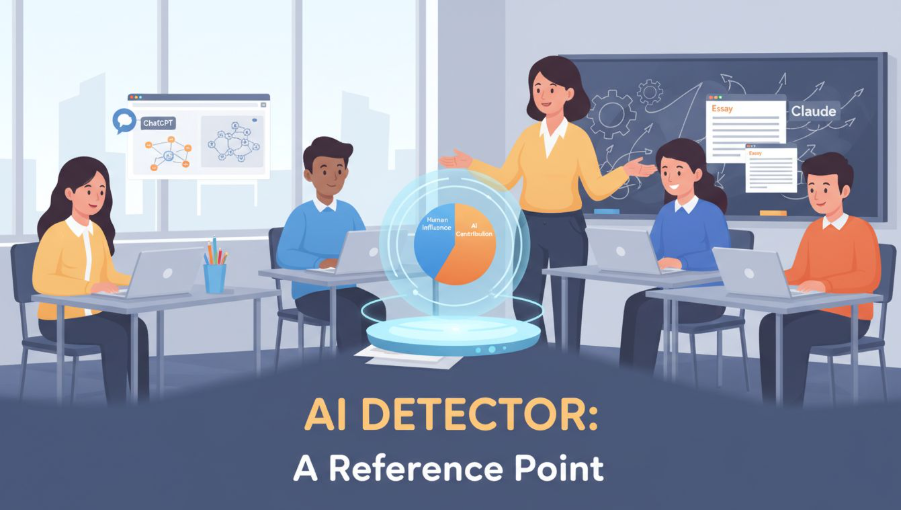
In most classrooms today, AI is already part of the writing process whether schools officially allow it or not. Students brainstorm with ChatGPT, restructure essays using Claude, and polish language with Gemini. In this environment, an AI Detector has become a reference point for understanding how much of a submission is influenced by artificial intelligence rather than a traditional “proof of cheating.”
But the deeper shift is not about enforcement. It’s about how we now define writing itself when AI is always present in the background.
AI-assisted writing is no longer an exception in education
The assumption that students write everything from scratch is becoming less realistic. Writing today often happens in multiple stages, across multiple tools, with AI quietly involved at different points.
Why AI Detector tools are now part of normal academic workflows
In many universities, AI Detector systems are used as part of review workflows rather than disciplinary procedures. They help instructors understand whether a text is likely human-written, AI-assisted, or heavily generated.
However, the key point is that AI Detector results are rarely treated as final proof. Instead, they are used to guide further investigation—such as reviewing drafts or asking students to explain their writing process.
This reflects a broader shift: AI Detector tools are being used to interpret writing behavior, not to deliver verdicts.
The reality of layered writing processes
Very few modern student essays are written in a single uninterrupted session.
A student might generate ideas using AI, expand them manually, reorganize structure later, and then refine language at the end. By the time the assignment is submitted, the writing is the result of multiple overlapping inputs.
An AI Detector cannot reconstruct that process. It only sees the final output, which means it evaluates structure rather than intention.
That limitation is central to understanding both the value and the limits of detection tools.
How Dechecker AI Detector interprets academic writing patterns
Dechecker’s AI Detector focuses on structural and statistical characteristics of writing rather than surface-level phrasing or vocabulary choice.
Why formal academic writing often resembles AI output
Academic writing is designed to be clear, structured, and logically consistent. It avoids unnecessary variation and prioritizes readability.
Interestingly, these same traits are common in AI-generated text.
As a result, even fully human-written essays can appear similar to AI-generated content when analyzed by an AI Detector. The system is not identifying “AI language,” but rather identifying structural regularity.
This is why interpretation matters more than raw detection scores.
AI Detector scoring as probability, not certainty
An AI Detector does not claim to know who wrote a text. Instead, it produces a probability score based on how closely the writing resembles known AI-like patterns.
In academic environments, this score is usually treated as a signal for review rather than a definitive conclusion. A high score might prompt closer examination of drafts or writing history, while a low score simply indicates more natural variation.
The key point is that AI Detector output must always be contextualized.
Why false positives are unavoidable in education
Students who prioritize clarity, grammar accuracy, and formal tone often produce highly structured writing.
This is especially common among non-native English speakers who aim for correctness over stylistic variation.
Because of this, AI Detector systems frequently flag legitimate student writing as AI-like. This is not necessarily an error—it is a reflection of how similar structured human writing is to machine-generated text.
Using AI Detector feedback to improve writing skills
Although AI Detector tools are often discussed in the context of academic integrity, they can also be used constructively as part of the learning process.
How students can interpret AI Detector results
When writing is flagged as potentially AI-generated, it usually signals low variation in sentence structure or overly consistent phrasing.
Instead of treating this as a problem, students can use it as feedback to improve writing style awareness.
Over time, this helps them recognize patterns such as repetitive sentence lengths, overly uniform transitions, or lack of rhythm variation.
This kind of awareness is often more valuable than the score itself.
The role of AI Humanizer in refining academic writing
After receiving feedback, some students use rewriting tools to improve readability. An AI Humanizer helps adjust sentence flow, introduce variation, and make writing feel more natural while preserving meaning.
When combined with AI Detector feedback, it creates a simple improvement loop: draft, analyze, adjust, and refine.
This loop is increasingly common in environments where AI is integrated into learning rather than excluded from it.
AI Detector as a subtle writing development tool
Repeated exposure to AI Detector analysis helps students develop awareness of their own writing habits.
They begin to notice when their writing becomes too uniform or overly structured, even without external feedback.
In this sense, AI Detector tools can act as indirect writing coaches that improve stylistic awareness over time.
Academic integrity is shifting toward transparency rather than restriction
The presence of AI is forcing education systems to rethink how originality is defined and evaluated.
From banning AI to understanding AI usage
Many institutions are gradually moving away from strict AI bans. Instead, they focus on transparency—how AI tools were used in the writing process.
In this model, AI Detector systems are only one component of a broader evaluation framework that includes drafts, revision history, and student explanations.
They support understanding rather than enforcement.
Why writing process matters more than final output
Because AI Detector systems cannot reconstruct how a text was produced, universities are increasingly focusing on process-based evaluation.
Draft submissions, in-class writing tasks, and oral explanations are becoming more important than the final essay alone.
This reduces reliance on AI Detector scores as the primary measure of originality.
The future of AI Detector in education
AI detection will continue to evolve, but its role will become more interpretive and educational rather than punitive.
From detection scores to meaningful feedback
Future AI Detector systems are likely to move beyond simple probability scores.
Instead of only indicating “AI likelihood,” they may explain structural characteristics such as low variation, predictable rhythm, or uniform sentence construction.
This makes feedback more useful for learning and improvement.
AI Detector as part of AI literacy development
As AI becomes a permanent part of education, students need to understand how AI-generated writing behaves.
AI Detector tools help make these patterns visible, contributing to AI literacy as a core academic skill.
This understanding is becoming as important as traditional writing ability.
Final perspective on AI Detector in modern education
In 2026, the goal is no longer to separate AI writing from human writing completely.
It is to understand their interaction.
An AI Detector is simply one tool in that system—helping educators and students navigate a reality where writing is increasingly a collaboration between human thinking and machine assistance.